

Students from TH Köln take on the IFAT World University Challenge
When students from TH Köln step onto the stage at IFAT Munich (4-7 May 2026), they bring more than technical knowledge. This is especially true for those competing in the World University Challenge, who bring firsthand experience of water challenges – from flood risk management in Sudan and sustainability projects in Egypt to engineering practice in Mexico and environmental work in Pakistan.
For some, these challenges are not abstract. “Water is not just an academic subject – it is something I have lived with as a real and urgent challenge my entire life,” says Ahmed Abobaker Osman Mohamed, recalling his experience growing up in Sudan.
The participants in the Challenge are part of the Master’s program Integrated Water Resources Management (IWRM) at the Faculty of Spatial Development and Infrastructure Systems. Students from this faculty’s Master’s programs Renewable Energy Management (REM) and Natural Resources Management and Development (NRM), as well as the Bachelor’s program Spatial Development and Infrastructure Systems, will also be involved at IFAT in various roles.
Together, the students represent the international and interdisciplinary character of TH Köln – and share a common ambition to develop sustainable solutions to real-world water problems.
Two teams, one shared mindset
The students competing in the challenge bring together different academic paths, professional experiences and cultural perspectives – yet their collaboration follows a similar pattern.
One team consists of Mubashira Sitarish (Pakistan), Maham Akram (Pakistan) and Riham Serag (Egypt). They first met during a DAAD language course before starting their studies and have been working together ever since. “We’ve built a strong friendship and developed a good understanding of each other’s working styles,” says Mubashira.
The second team brings together Ahmed Abobaker Osman Mohamed (Sudan), Maher Abdalla (Sudan) and Marco Juárez (Mexico). Their collaboration builds on prior academic and professional experience, combining engineering expertise, research and hands-on work in the water sector.
What connects both teams is a shared approach: clear role distribution, mutual trust and the ability to work efficiently under pressure – skills that are essential both for the competition and for real-world water management.
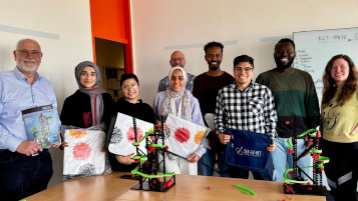
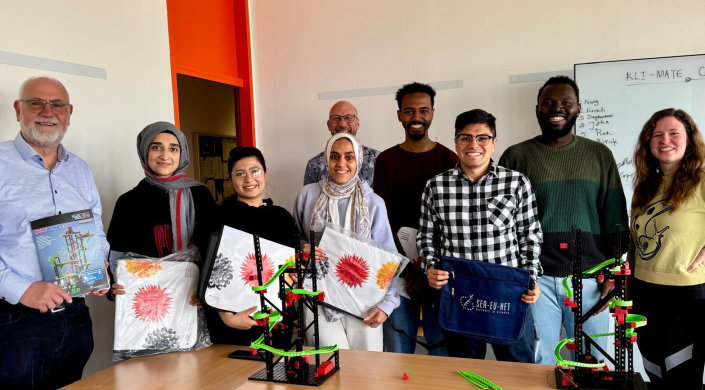 From the left: Rüdiger Heidebrecht (Coach), Mubashira Sitarish (Team 1), Maham Akram (Team 1), Riham Serag (front, Team 1), Prof. Ralf Engels (rear, Coach), Ahmed Abobaker Osman Mohamed (Team 2), Marco Antonio Juárez Sánchez (Team 2), Maher Abdalla (Team 2), and Cassie Tragert (Student Assistant)
(Image: TH Köln)
From the left: Rüdiger Heidebrecht (Coach), Mubashira Sitarish (Team 1), Maham Akram (Team 1), Riham Serag (front, Team 1), Prof. Ralf Engels (rear, Coach), Ahmed Abobaker Osman Mohamed (Team 2), Marco Antonio Juárez Sánchez (Team 2), Maher Abdalla (Team 2), and Cassie Tragert (Student Assistant)
(Image: TH Köln)
A competition that mirrors reality
The World University Challenge is designed to simulate real-world decision-making under pressure. Participants are required to combine technical expertise, strategic thinking and teamwork across three core tasks:
- negotiating water allocation between competing stakeholders,
- optimizing wastewater treatment processes using simulation software,
- solving practical engineering challenges in water systems.
“It is part strategy game, part engineering test, and part negotiation exercise,” Ahmed explains – all centered around one of the world’s most critical resources.
This structure reflects integrated approaches to water management, combining technical, environmental, political and social perspectives.
Learning to perform under pressure
Preparation for the challenge has been intensive. Supported by mentoring, practical exercises and simulation training, the students have been working through realistic scenarios and learning new tools such as the SIMBA software.
“The biggest challenge will be managing limited time to solve an unfamiliar problem as a team,” says Mubashira.
To address this, both groups rely on structured teamwork. Tasks are distributed according to individual strengths, while continuous communication ensures coordinated decision-making. Flexibility remains key, as roles may shift depending on the task – a dynamic that closely reflects professional practice in water management.
From theory to impact
What makes the challenge particularly relevant is its direct link to real-world water management. The scenarios reflect current issues such as resource allocation, infrastructure planning and system optimization.
For the students, the competition is an opportunity to apply academic knowledge in a practical context and to develop solutions that are both technically sound and sustainable.
At the same time, it reinforces a central principle of modern water management: that effective solutions require interdisciplinary thinking, combining engineering, environmental science, governance and social considerations.
Representing TH Köln on a global stage
Competing at IFAT Munich offers more than a test of skills. It provides access to an international network of experts, technologies and ideas in the water sector.
Beyond the competition, IFAT also provides a platform for many more TH Köln students from different programs, who contribute in various roles across the fair.
For the participants in the challenge, it is also an opportunity to represent TH Köln and demonstrate the strengths of their academic training. As Marco Juárez describes it, the challenge is “a unique chance to compete internationally in the field I love to work with.”
More than a competition
While success in the competition is an important goal, the experience itself goes far beyond rankings.
It is about developing solutions that respond to complex global challenges, working effectively across cultures and disciplines, and gaining the confidence to operate in international professional environments.
As team member Mubashira Sitarish puts it, success ultimately means “performing confidently with my team and delivering well-thought-out solutions, regardless of the final result.”
April 2026