



Play a Serious Game about Studying with Mental Health Challenges: Beyond the Chalkboard
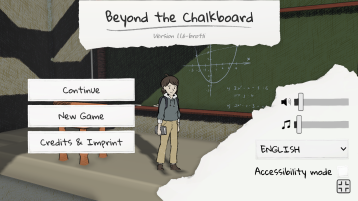
Step into the role of Sam: Visit the university, meet lecturers and fellow students, and experience the world of Beyond the Chalkboard (BtC). Encounter limitations caused by environmental barriers, the reactions of others, as well as Sam’s anxieties and feelings of depression. On this website, you will find access to the BtC game, instructions on the game’s controls, and further information.
Jump to
Before Playing
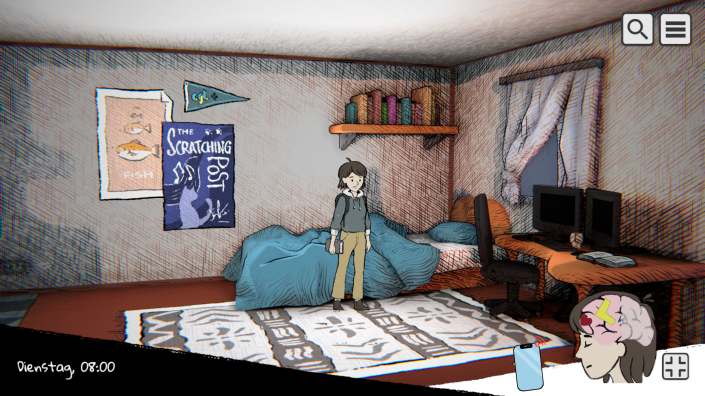 Game Character Sam stands in a private room.
(Image: ZLE, TH Köln)
Game Character Sam stands in a private room.
(Image: ZLE, TH Köln)
Beyond the Chalkboard is played in the browser. By clicking on the left mouse button, you can move the main character Sam around the room, interact with objects and people, and react in dialogues. The intro at the beginning of the game provides further details.
Important Notice
The serious game Beyond the Chalkboard tries to make aspects of living with a mental illness tangible. If you notice that playing causes you emotional distress, please talk to others and do not continue playing alone. You can find further support services here.
If you have questions or technical problems while playing the game, click here.
Play Beyond the Chalkboard Now
Visit the game’s website and try Beyond the Chalkboard right now.
Start Game
While Playing
- Please use another browser if the game does not open.
- You can play the game in an accessibility mode and select German or English as the game’s language. If you notice any barriers to accessibility, we welcome your feedback by email.
- If the game freezes, you can restart the scene via the menu.
You can find more information in the FAQ.
A Look Into The Game
 0 / 0
0 / 0
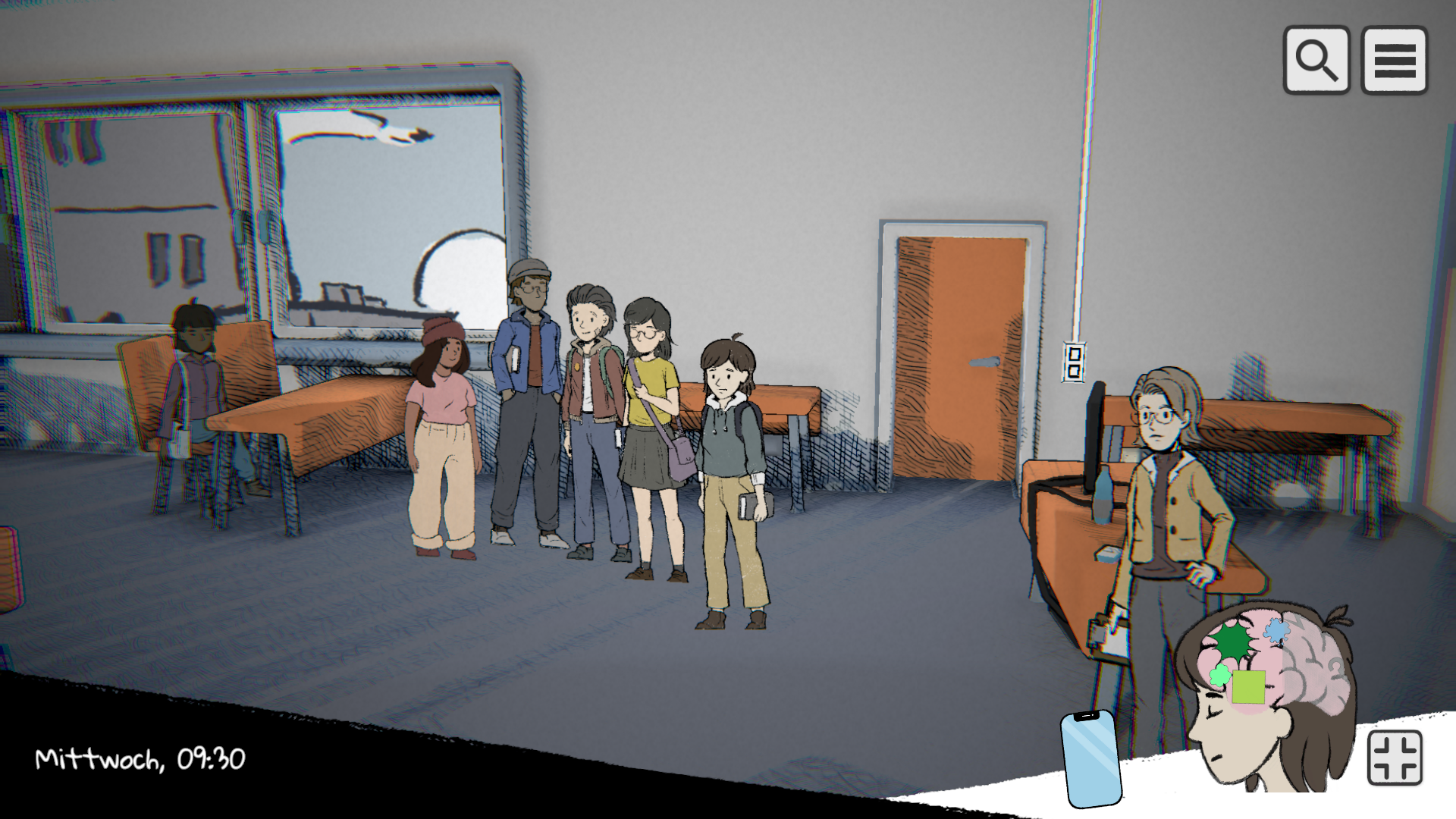
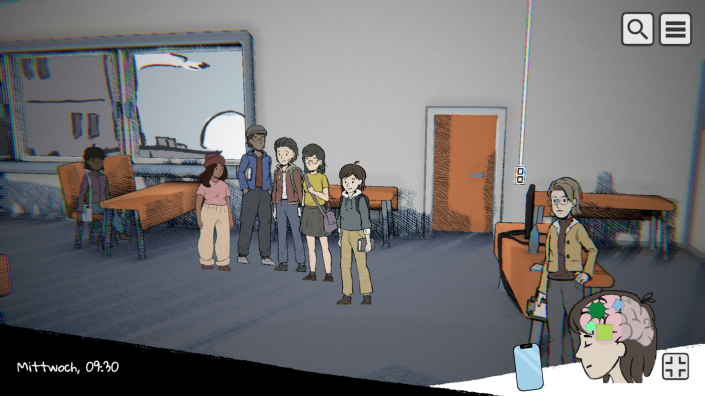
Sam stands with fellow students in a seminar room; a lecturer is at the podium. (Image: ZLE, TH Köln)
 0 / 0
0 / 0
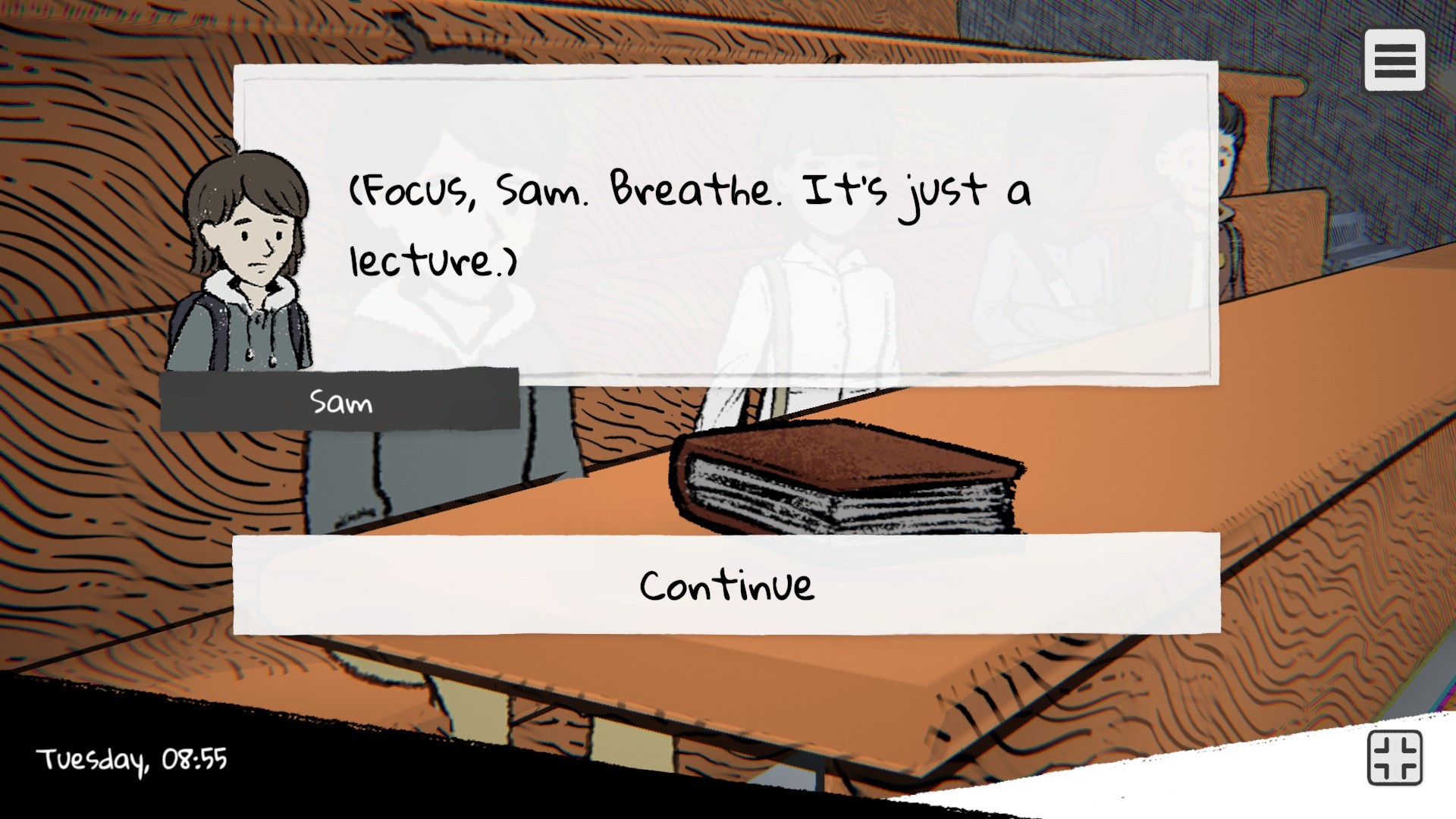
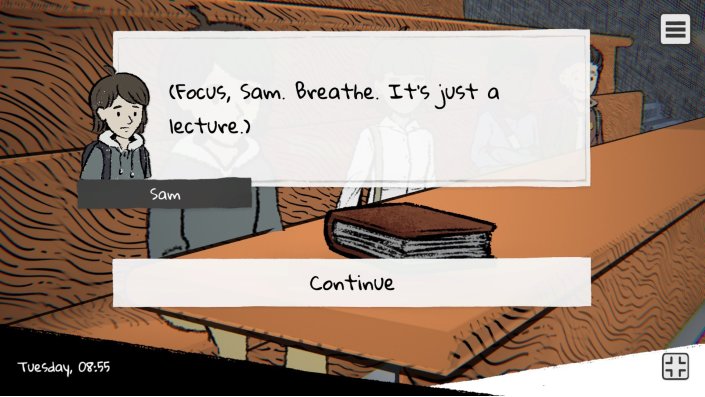
Sam sits at a desk in the lecture hall. A dialogue window shows Sam’s thoughts: "(Focus, Sam. Breathe. It’s just a lecture.)" (Image: TH Köln/ Spoonful)
 0 / 0
0 / 0
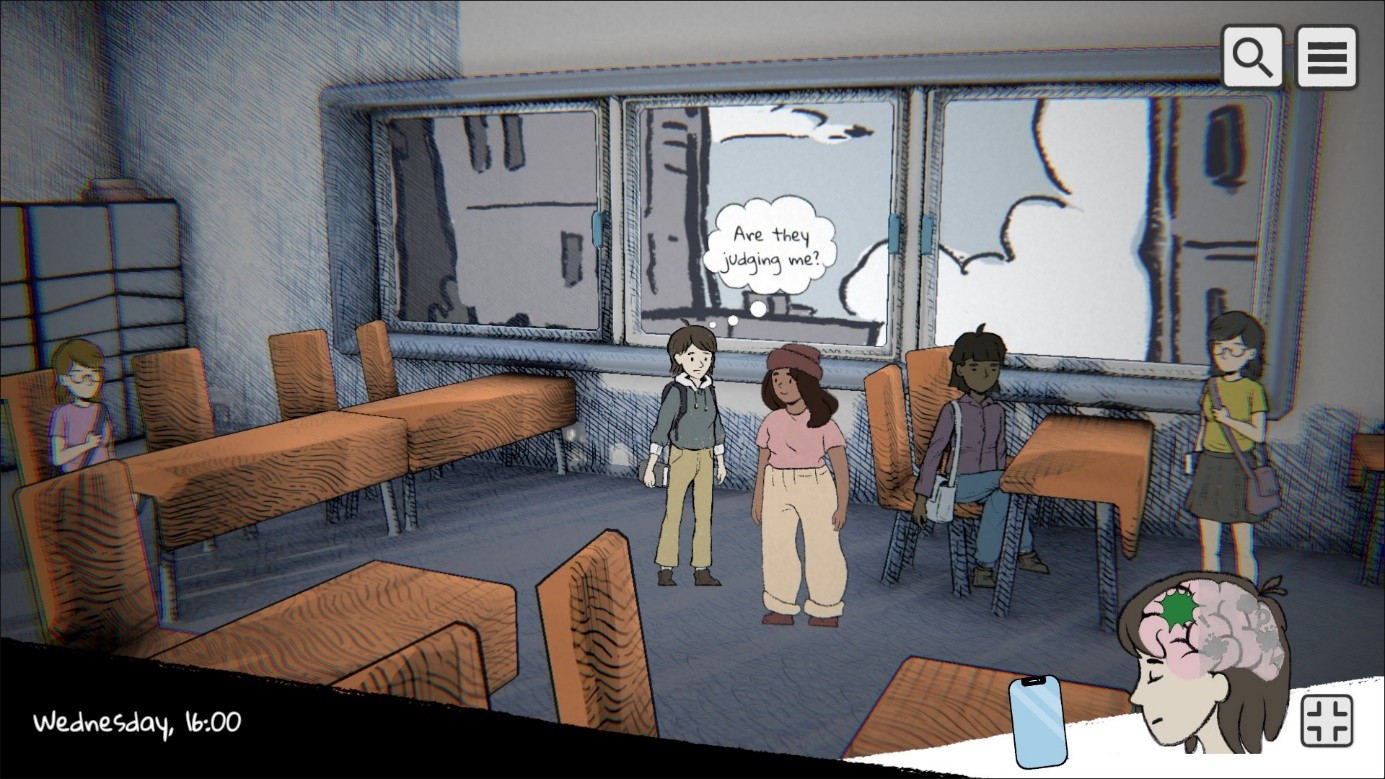
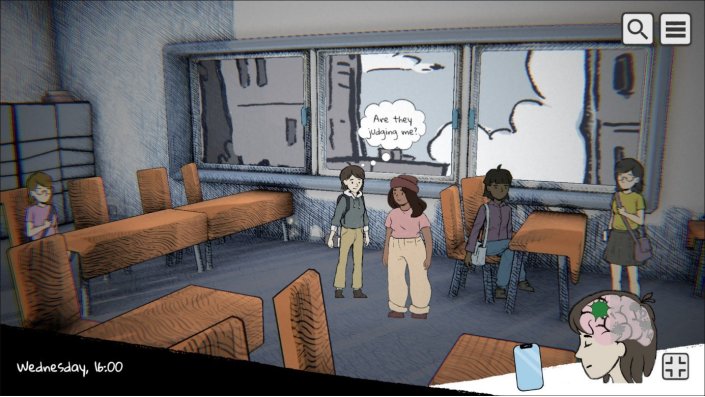
In the seminar room, Sam is surrounded by some classmates. There is a thought bubble above Sam’s head: "Are they judging me?" (Image: TH Köln/ Spoonful)
 0 / 0
0 / 0
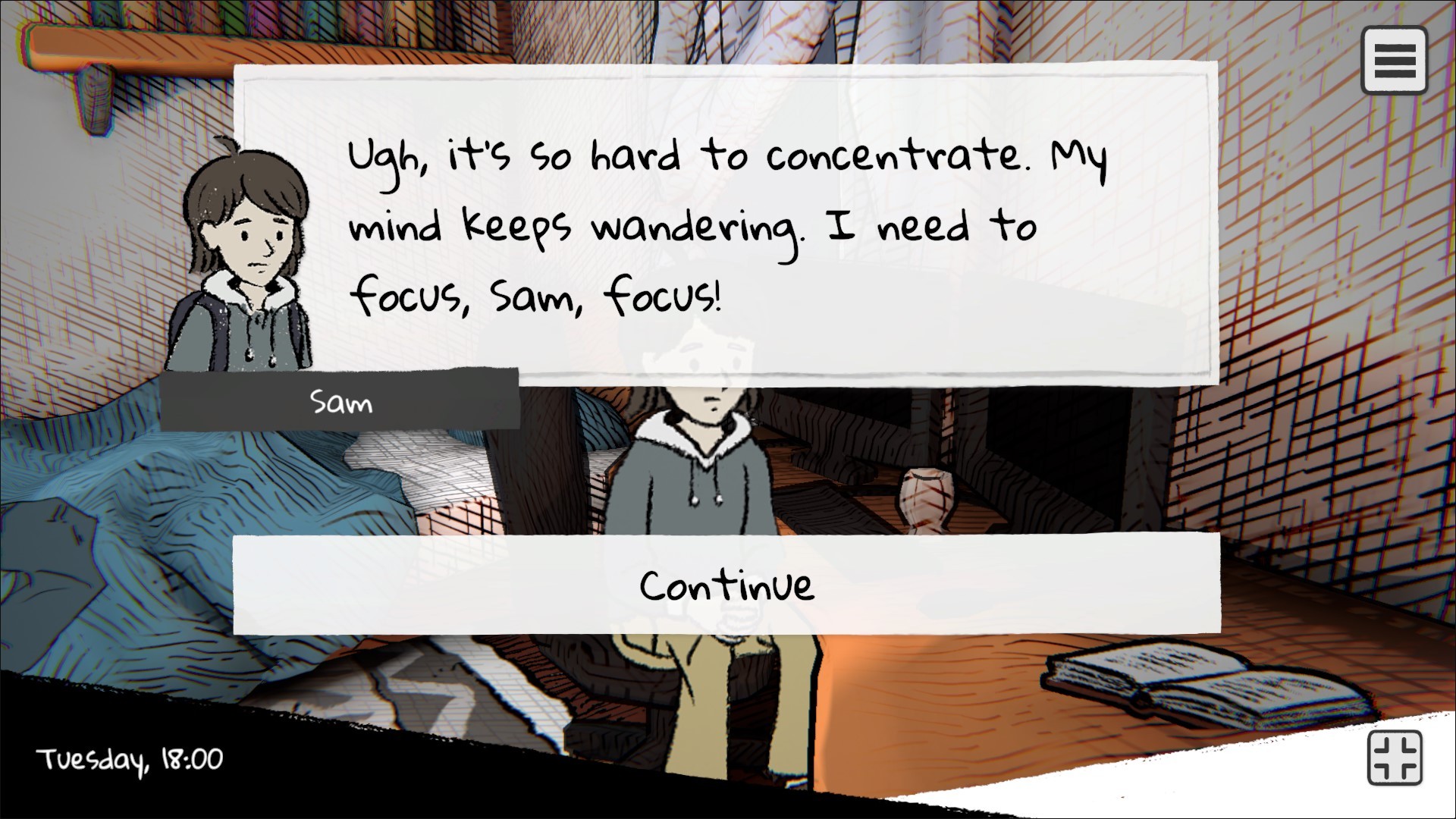
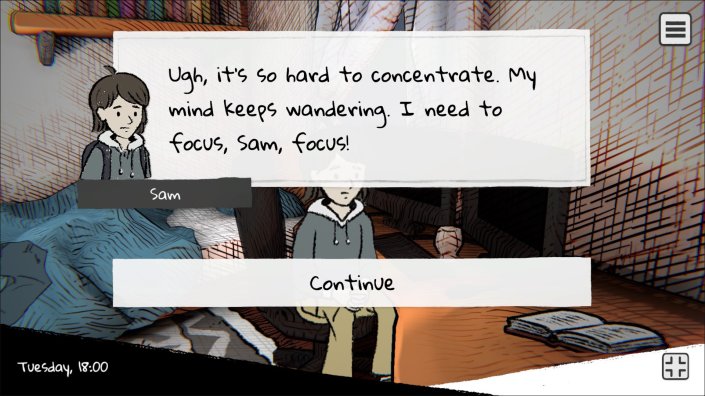
Sam sits at a desk. A dialogue window shows: "Ugh, it’s so hard to concentrate. My mind keeps wandering. I need to focus, Sam, focus!” (Image: TH Köln/ Spoonful)
After the Game – Beyond the Chalkboard in Workshops
There is a pedagogical guide for the serious game BtC available on “Lehrpfade”. It supports you in integrating the game into educational settings.
Invitation to Reflect on the Gaming Experience
If you play the game on your own and would like to reflect on your experience, we suggest the following questions. You can answer them in writing and use your conclusions to modify your lecture design.
- How did you experience the game?
- What barriers did you perceive for Sam? Which of these barriers were particularly significant for Sam?
- What was or could be supportive for Sam?
- Where do you see opportunities to increase flexibility or proactively approach students who might be struggling?
- How can you, as a lecturer or staff member, contribute to creating an environment that is accessible and diversity-friendly?
- Are you familiar with the counseling services offered by your university? How can you signal openness and support to students in conversation, without taking on the role of a therapist yourself?
- If you have questions or need advice, please contact: barrierefrei@th-koeln.de
Find Support
General Services
The Telephone Counseling Service (Die Telefonseelsorge) is available 24/7. You can text or call free of charge with counselors (0800-111 0 111, 0800-111 0 222, or 116 123). The service is only available in German but they have an overview of similar services in other languages on their website. (Internationale Hilfe - TelefonSeelsorge® Deutschland)
In emergency situations, please contact emergency services at 112 (Europe) or the police at 110 (Germany).
TH Cologne Services
Support for students of TH Cologne in personal crises & situations of stress.
Psychological counseling at the Cologne Student Services (KSTW): This service is also available in English.
Other Universities
Your university may also offer support services. Please check your university’s website for information.
FAQ
Alternative Access Links to the Game
Beyond the Chalkboard is designed to launch the version appropriate to your browser. If you experience difficulties, you can try switching your browser or directly access the respective version at:
https://beyondthechalkboard.web.th-koeln.de/32/ (32-bit)
or
https://beyondthechalkboard.web.th-koeln.de/64 (64-bit)
If you encounter more difficulties, please contact: barrierefrei@th-koeln.de.
Game Mechanics
You are playing the main character Sam, going through daily university life. You can make your own decisions, which influence the course of the game.
The game is designed in a way that allows even inexperienced players to quickly find their way. Give it a try! If you still have questions, you can find detailed explanations below.
- The game uses point-and-click mechanics: The entire game is controlled with the mouse. To move Sam, click on the spot you want to go to. By clicking on objects and people, you can interact with them. A click on the magnifying glass at the top right corner gives you hints about what you can interact with.
- On the third in-game day, your options as a player change. This is intentional and reflects Sam’s emotional and mental state.
- You can close the game and continue playing at a later time. To do this, click “Continue” in the main menu. The game then starts at the beginning of the last scene you played.
- You can reload the scene via the menu, which will restart it from the beginning.
- Volume and music can be adjusted separately via the menu.
- You can play the game in German or English, and switch languages anytime via the menu.
- You can turn the accessibility mode on or off at any time via the menu. For more information, see the FAQ: Accessibility.
- A graphic of Sam’s brain appears at appropriate points in dialogues or can be accessed via the graphic of Sam’s head at the bottom right corner of the screen. Inside Sam’s brain, various thoughts appear as colorful shapes. Hovering the mouse over a thought will display its description. Part of Sam’s brain is always covered by fog, which grows or shrinks and darkens or lightens throughout the game. Thoughts inside the fog cannot be executed until you drag them out of the fog using the mouse. Thoughts in dark fog cannot be moved. Positive thoughts appear in a thought bubble next to the brain graphic; by clicking on these, the fog inside the brain shrinks.
- You can access Sam’s phone via the phone icon at the bottom right. Through the phone, you can chat with Luis, a friend living elsewhere, or use various apps. When a new message from Luis arrives, a red circle with a “1” appears at the top right corner of the phone icon.
Accessibility
To make the game accessible to as many as possible, we have made efforts to make the game playable for a variety of people. The game is designed as point-and-click, however, which entails some operational limitations. For example, using a mouse is necessary.
The accessibility mode can be selected in the starting menu and at any time during gameplay.
This mode affects the game as follows:
- The font “Dyslexia” is used for better readability.
- In regular mode, BtC’s graphics have a stop-motion effect with the background constantly moving. In accessible mode, the visuals are calm and static.
- The game mechanics in Sam’s brain are adjusted: thoughts have no weight and only need to be clicked instead of dragged with the mouse held down.
Generally, the design follows the Game Accessibility Guidelines (GAG). According to these, Beyond the Chalkboard is classified as “Basic”. Here you can find a list of the implemented accessibility standards in German and English.
Development Process
The game was created in a collaboration of students and staff at TH Köln. For more information, we recommend the following publication:
Alfeld, Jasmin; Groß-Elixmann, Klara & Fischer, Nadine: "'Beyond the Chalkboard' or: How a Serious Game Contributes to Reducing Barriers." In: PAIDIA – Journal of Computer Game Research. 27.03.2025, https://paidia.de/serious-game-abbau-von-barrieren/.
Spoiler Warning: About the Content
Paradoxical Game Logic
Beyond the Chalkboard operates with a partly paradoxical logic. For example, the thought of eating might be inaccessible in the thought world due to fog, yet Sam cannot leave the apartment in the game without having breakfast. This reflects tension between digital game design and real-world logic. Due to this paradox, “winning” the game is not the focus. The focus lies on simulating Sam’s everyday life as a student. The goal of the game is to raise awareness for barriers in higher education, not to “save” Sam.
Individual vs. Systemic Barriers
Mental illnesses lead to individual challenges and also expose affected persons to systemic barriers. We want to focus on raising awareness for systemic barriers. However, at the same time an understanding of Sam as a person is also necessary for an immersive experience. Beyond the Chalkboard addresses this tension.
Alcohol Use in the Game
The depiction of alcohol in the game aims to portray student life situations realistically. It is in no way intended to present alcohol use as a solution.
Explanation of Different Endings
The game can lead to three possible endings. The outcome depends on the decisions made earlier in the game:
- Withdrawal
Sam stays in the apartment with minimal further interactions. At the end, a concerned message from Luis flashes up. This ending occurs if social contacts are maintained hardly or not at all.
- Breakdown
Sam goes to the university but perceives little of the world around them and ends up sitting alone on the benches. This ending results from low success at university.
- Call for Help
Sam opens up to Elli and Saba and seeks support offers. At the end, Sam stands at the window and a positive message from Luis flashes up. This ending occurs when Sam maintains contact with other characters and opens up.
Give us Feedback!
Have you played BtC? We are looking forward to hearing your feedback on your experience, so that we can further improve our information services. Please visit this page to share your feedback.