



Restorative and conservative handling of Jaina miniatures
Removal of adhesive tapes and mechanical stabilization in copper-damaged areas
At a glance
| Kategorie | Beschreibung |
|---|---|
| Student project | Restorative and conservative handling of Jaina miniatures |
| CICS department | Documents, graphics, photography and book illumination |
| Student | Maleen Wittich, B.A. |
| Supervisors | Prof. Dr. Andrea Pataki-Hundt |
| Marlen Börngen, M.A. | |
| Project partners | Rautenstrauch-Joest-Museum, Cologne |
| Duration | 2021 |
Picture gallery
 0 / 0
0 / 0
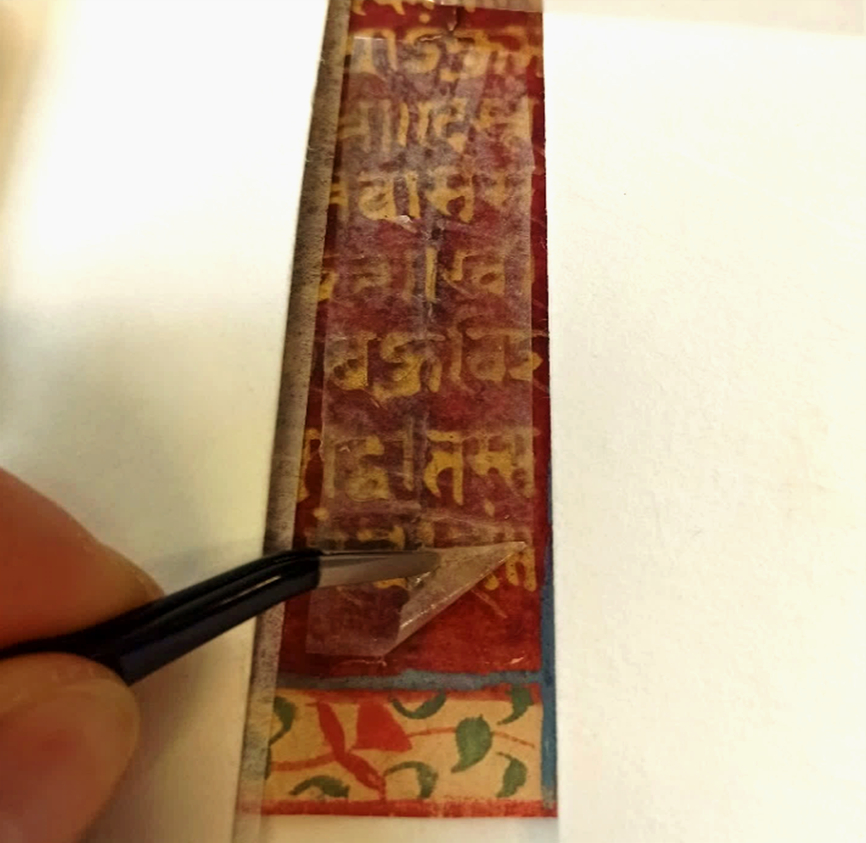
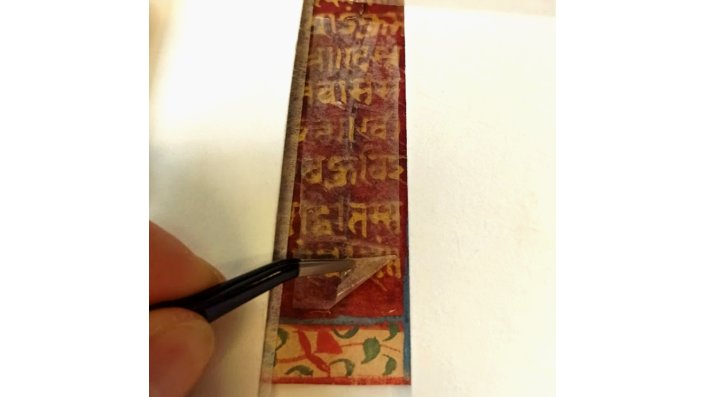
Removal of the adhesive tape after application of the MH-compress on Folio 68193_30 Verso. (Image: TH Köln - CICS - Maleen Wittich)
 0 / 0
0 / 0
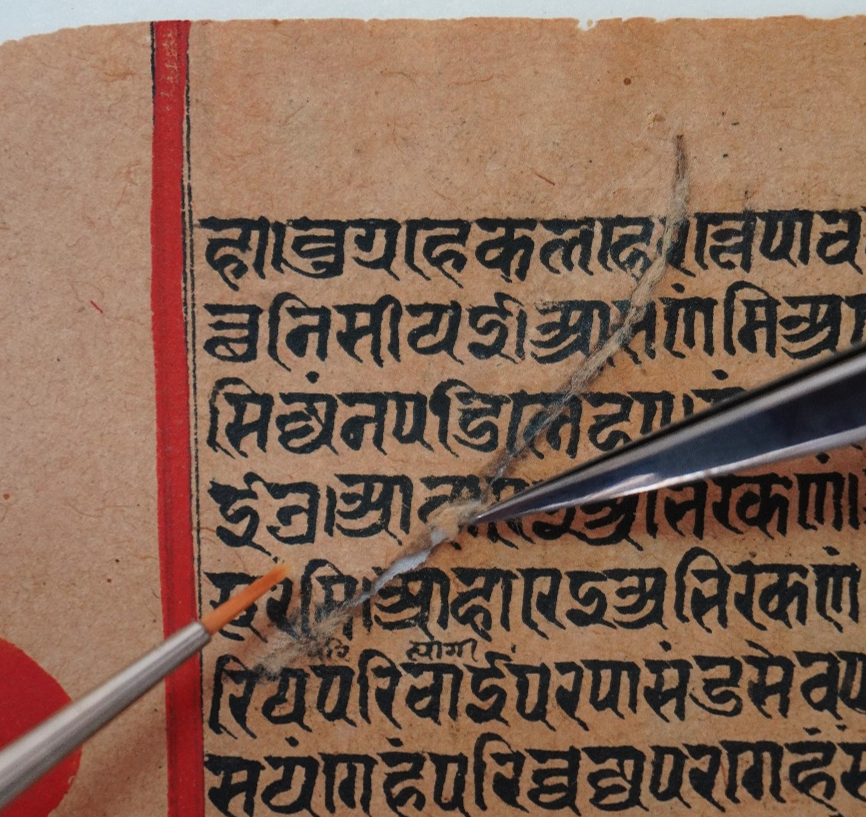
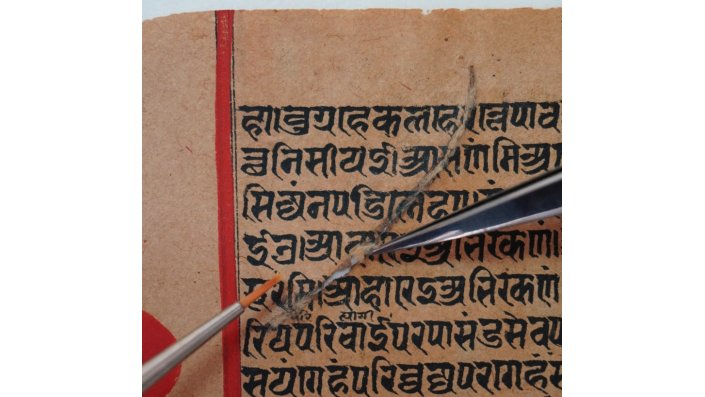
Folio 68189 Verso. Mechanical stabilization and securing of the crack caused by copper corrosion with loss of material by inserting Japan paper inserts. (Image: TH Köln - CICS - Maleen Wittich)
 0 / 0
0 / 0
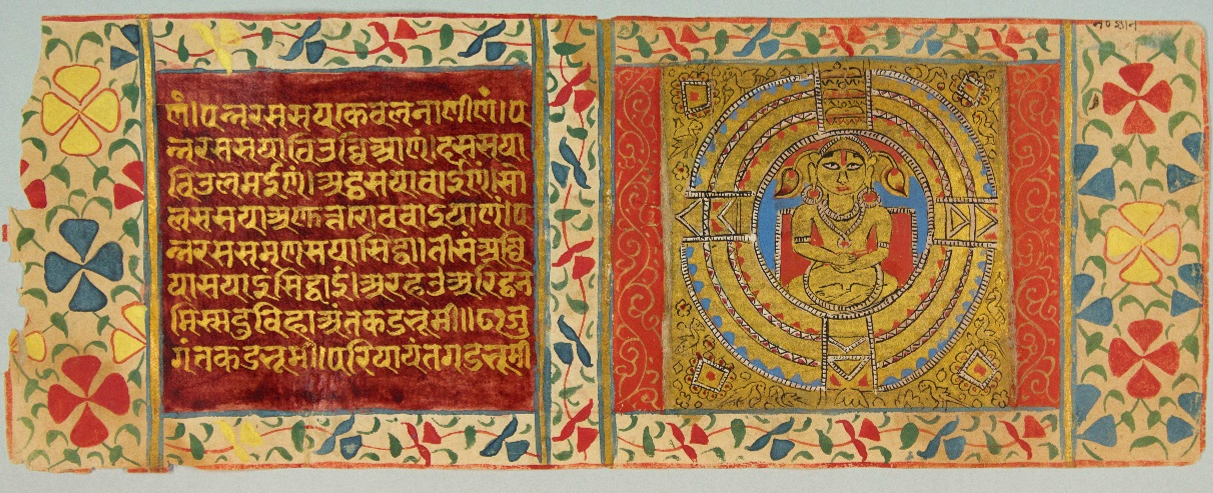
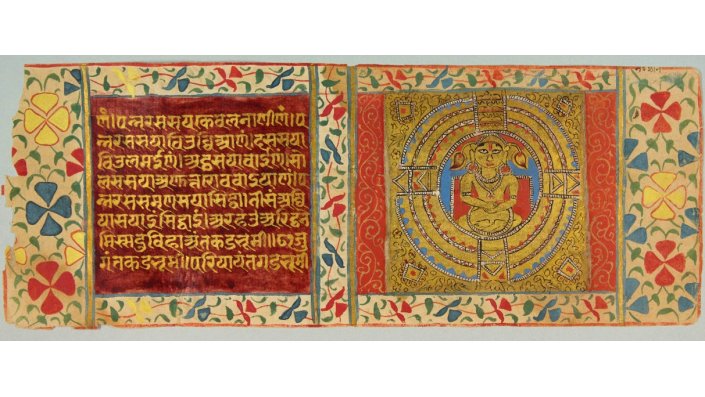
Folio 68193_30 Recto. After state. The Japanese paper inserts were applied from the image side and stabilized by "Remoistable Tissue" (see black framed area). The image area and writing area on the other side are not covered. (Image: TH Köln - CICS - Maleen Wittich)
As part of a bachelor’s thesis, the restoration and conservation of four selected Jaina miniatures from the Rautenstrauch-Joest-Museum (RJM) in Cologne was elaborated. The manuscripts with miniatures and texts on both sides play an important role in the practice of the religious life of Jainism. They provide information on morally correct behaviour and contain the teachings and ideas of the indian religious community. The structure of the folios follows a certain scheme and iconographic image programs repeat themselves.
Damages and aim of conservation
The damage is defined by cracks and losses in the text and image area caused by a corroded copper green pigment. These fragile areas were covered with different adhesive tapes which are not from the date of origin. The restoration focused on the removal of these adhesive tapes and on the mechanical stabilization and securing of the miniatures. The aim of the measures was to improve the readability and visual appearance relating to the ethical principles of the Jaina culture. By securing and restoring the exhibition capacity, the miniatures are to be made accessible to present and future generations.
Material analysis
To analyse the material of the different adhesive tapes, the “Fourier Transformation Infrared Spectrometry” (FTIR) was applied. The results show that the adhesive tapes are predominantly composed of paper with different additives, which have been coated with an organic adhesive. One of the adhesive tapes could be precisely determined: It is the self-adhesive polyacrylate film “filmolux”.
Since a large number of materials were used in the production of the manuscripts in India, the material analysis of the fibres is an interesting research approach. By executing microscopic and microchemical fibre analyses, the identification of Indian paper manuscripts was approximated. Two different types of material were identified: Three of the four selected folios are probably bast or leaf fibers, such as Sunn, Kenaf, Manila or Ramie. In the fourth folio, the presence of grass fibres, such as bamboo or rice straw, is not unlikely.
Measures
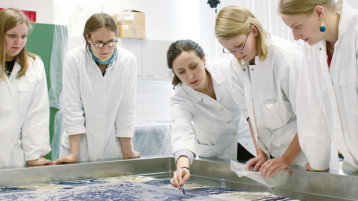
A 10% MH gel compress (30.000) was used to remove the adhesive tapes. The identified self-adhesive film “filmolux” was activated by the action of heat and was mechanically removed. Due to short-term humidification and smoothing, cocklings could be reduced. Klucel G 2. 5% in ethanol w/v was used for the insertion of inlays made of coloured Japanese paper into the losses. “Remoistable tissue” was applied to stabilize and secure the areas. For this purpose, a Japanese paper with a weight of 1. 6 g/m² was coated with Klucel G. The adhesive was reactivated by moistening with ethanol. The cellulose ether Methocel A4C, 0. 2%ig, was selected for the consolidation of the painting layer. According to the ethical Jaina principle of nonviolence towards all living beings, the use of common animal glues for consolidatoion, such as isinglass, would not be appropriate.
Results
The developed concept was implemented satisfactorily. The harmful adhesive tapes were removed without leaving any residue and the fragile areas damaged by copper eruption were stabilized and secured with age-resistant materials without covering the text or image area. The restorative and conservative treatment of the Jaina miniatures as well as the approaches to fiber analysis can serve as a basis for future restoration work and research on other illuminated Jaina manuscript leaves.