

Webinar Digital Agriculture and Model-Data Integration for Resilient African Croplands: 17 Feb 2026
Webinar, 17/02/2026
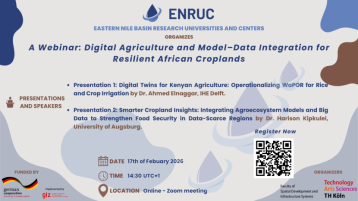
Within the framework of the webinar series organized by the ENRUC project, we are pleased to announce the upcoming webinar episode under the theme Digital Agriculture and Model-Data Integration for Resilient African Croplands, hosted on Zoom on 17 February 2026 at 14:30 CET (duration: 1 hour 30 minutes).
At a Glance
Digital Agriculture and Model-Data Integration for Resilient African Croplands
WebinarWhen?
- 17/02/2026
- 14:30 to 16:00
-
add to my calendar
BEGIN:VCALENDAR VERSION:2.0 PRODID:-//hacksw/handcal//NONSGML v1.0//EN CALSCALE:GREGORIAN BEGIN:VTIMEZONE TZID:EUROPE/BERLIN BEGIN:DAYLIGHT TZOFFSETFROM:+0100 TZOFFSETTO:+0200 TZNAME:CEST DTSTART:19700329T020000 RRULE:FREQ=YEARLY;BYMONTH=3;BYDAY=-1SU END:DAYLIGHT BEGIN:STANDARD TZOFFSETFROM:+0200 TZOFFSETTO:+0100 TZNAME:CET DTSTART:19701025T030000 RRULE:FREQ=YEARLY;BYMONTH=10;BYDAY=-1SU END:STANDARD END:VTIMEZONE BEGIN:VEVENT LOCATION:Online via ZOOM DESCRIPTION: SUMMARY:Digital Agriculture and Model-Data Integration for Resilient African Croplands DTSTART;TZID=EUROPE/BERLIN:20260217T143000 DTEND;TZID=EUROPE/BERLIN:20260217T160000 DTSTAMP:20260722T200458 UID:6a61226adf615 END:VEVENT END:VCALENDAR
Where?
Online via ZOOM
Information & Registration
Costs
Free of charge
Academic coordinator
Coordination: Chahinaz Ziani, TH Köln
Speakers:
Dr. Ahmed Elnaggar, IHE Delft
Dr. Harison Kipkulei, University of Augsburg
Registration
Registration Register here
This webinar will feature two distinguished presentations:
Presentation 1: Digital Twins for Kenyan Agriculture: Operationalizing WaPOR for Rice and Crop Irrigation. by Dr. Ahmed Elnaggar, IHE Delft.
Dr. Elnaggar will demonstrate two operational decision-support tools that leverage open-access satellite data like FAO WaPOR and Python modeling to provide daily irrigation prescriptions for Kenyan farmers. These include the Rice Paddy Advisor, specialized for flood-based rice schemes to model ponding depth and bund management, and the Crop Water Advisor, a precision tool for upland crops that optimizes soil moisture to prevent stress.
Presentation 2: Smarter Cropland Insights: Integrating Agroecosystem Models and Big Data to Strengthen Food Security in Data-Scarce Regions by Dr. Harison Kipkulei, University of Augsburg.
Dr. Kipkulei will explore how process-based agroecosystem models integrated with remote sensing data – such as vegetation, soil moisture, and land use indicators – enable evaluation of cropland conditions, spatially explicit climate risk assessments, and climate-smart agricultural decisions in regions like the Nile Basin and Sub-Saharan Africa. The focus will be on simulating crop growth, yield dynamics, and management impacts amid climate variability, while addressing challenges and opportunities to build resilience and sustainability in vulnerable farming systems.