Around the world in 16 fellows: Prof. Dr. Moti Gigi
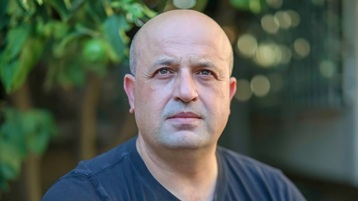
This year and next, sixteen researchers from thirteen countries will be conducting their research and teaching at TH Köln as International Fellows. One of them is Prof. Dr. Moti Gigi. In this interview, he shares how the events following October 7th informed his stay at TH Köln, what poetry and food have got to do with cultural exchange, and how Cologne’s contrasts endeared the city to him.
Name: Prof. Dr. Moti Gigi
Home universitiy: Sapir Academic College, Israel
Hosting faculty at TH Köln: Faculty of Information Science and Communication Studies
Fellowship title: Political polarization in Germany and Israel
Duration of stay: 1 August – 31 October 2025
I was interested in the International Fellowship because...
it provided the essential framework for deepening my DAAD-funded research collaboration with my colleague Lars Rinsdorf. After 30 years of visiting and working in Germany in various contexts, this fellowship offered the time and space to truly build something meaningful – a joint Israeli-German course and research project examining media polarization between Israel and Germany following October 7th.
Specifically, during the fellowship I wanted to...
co-develop our international MA course and advance our comparative research on media analysis in both countries. We also presented preliminary findings at the European Association for Israeli Studies (EAIS) conference in Potsdam in September, which helped us refine both our research questions and pedagogical approach.
During my time in Germany, I wanted to find out...
how to create genuine dialogue about one of the most polarizing events of our time. Through our research and teaching, I explored how Israeli and German media narratives diverge and converge, and how students from both countries can engage in meaningful cross-cultural learning despite – or perhaps because of – the tensions. My experience living in Cologne during this period was profound enough that I wrote about it in an article published in Ynet (https://www.ynet.co.il/judaism/discourse/article/hjxidam2xg), reflecting on the daily encounters with memory and politics embedded in the city's streets – from Stolpersteine commemorating Holocaust victims to ever-changing graffiti expressing current Israeli-Palestinian tensions.
I think international exchange is...
not just an academic necessity but a moral imperative, especially in polarized times. It's about building bridges through scholarship while remaining intellectually honest about our differences. My "Politics from Love" evening in September – where we discussed Bialik and Darwish over shakshuka and wine with 14 German participants – exemplified this: real exchange happens when we bring our whole selves, including our national poets and our food, to the conversation.
Something that is different at my home university than at TH Köln is...
the context we work in. I come from Sapir Academic College in southern Israel, on the Gaza border, which has faced an incredibly challenging period over the past two years. Coming to TH Köln, I found an institutional openness to international collaboration even in complex times. I won't pretend that not speaking fluent German isn't a challenge – it definitely is, and I'm working on improving my language skills – but the welcoming atmosphere and the fact that collaboration is possible even without perfect German made this fellowship feasible and productive.
What I take back to my home university is that...
complex political topics can and should be taught comparatively and collaboratively. Our students benefit enormously from engaging with peers who hold different perspectives and media experiences. I'm also bringing back practical models for binational course design that we've refined during this fellowship.
What I like about TH Köln is that...
it combines academic rigor with genuine warmth. There's a sense that people here are connected to their institution and to Cologne itself. This connection – what I'd call a kind of civic pride – creates an environment where international guests feel welcomed not just as visitors but as temporary members of a community.
What I really wanted to experience in Cologne is...
the city's unique character – and I did! From attending FC Köln matches and experiencing the communal atmosphere in the bars when games are on, to improving my German (in preparation for our next student meeting in February 2026), from discovering Kölsch beer culture to understanding the city's famous liberalism and carnival traditions. What struck me most is the combination of things you rarely find together in a big city: wonderful food from all over the world, vibrant bar culture, strong community life, and yet – a sense of calm and quiet. This quality of urban life, where a major city maintains an almost village-like peacefulness, is something truly special about Cologne. Though I first visited in February 2025, the three months of my Fellowship allowed me to experience these rhythms of daily life, not just the highlights.
About PLan_CV
The International Fellows program is part of the project PLan_CV („Professur-Laufbahn an Hochschulen für angewandte Wissenschaften neu denken: Collaboration und Vernetzung“). Its goal: Finding excellent candidates for professorial careers at TH Köln and achieving greater permeability between the academic world and the business sector. The project’s budget of 12.4 million Euros is funded through the Federal Ministry of Research, Technology and Space program “FH-Personal” (staff for universities of applied sciences).
December 2025