

New Method for Wastewater Treatment
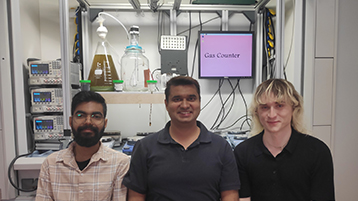
Industrial and municipal wastewater contains mixtures of pollutants in varying combinations, making treatment difficult. In the MicroNanoClean project, an approach was developed to directly break down various pollutants rather than simply filtering them out. In an interview, project leader Dr. Himanshu Himanshu from the :metabolon Institute explains the challenges and the approach taken.
What is the core problem the project addresses?
Wastewater from industry and municipalities often contains complex mixtures of pollutants that are difficult to treat with conventional methods in a single step. Depending on the source, the water may contain organic matter, nitrogen compounds such as ammonia, micro- and nanoplastics, and other pollutants in very different combinations and concentrations. Many existing treatment technologies are designed for one pollutant class or one water type and some only shift pollutants into a new waste stream instead of breaking them down. Our project MicroNanoClean therefore addresses a broader question: how can a wastewater treatment technology be developed that treats a wide range of pollutants in different kinds of water without generating secondary pollutants?
What is the main approach to solving this problem?
MicroNanoClean's answer is to move the point of action from separation to conversion: instead of a treatment step that concentrates or filters out pollutants for disposal elsewhere, the project develops materials and enzymes that actively break pollutants into basic building blocks or other recoverable resources. This shifts the engineering challenge from "How do we remove this" to "What material can convert this," which is why the project centres on developing new functional materials rather than a new plant layout. Because no single institution holds all the expertise this requires – from enzyme science to surface chemistry to environmental safety assessment – the project's first task was to build an international research collaboration of three academic partners and one deep-tech industrial partner across three EU countries, matched to the different pieces of the challenge.
What were the individual steps of the project?
At the centre of the project is the idea of a single-stage bioreactor – a device for controlling, conducting, and monitoring reactions between different substances – built around a functional scaffold material, such as biochar, designed for biocatalytic degradation and conversion of pollutants. The scaffold material serves as an active surface where pollutants are directly converted. To ensure sustainability from the outset, the carrier material is produced from municipal organic waste rather than specially grown raw materials or synthetic substances.
The team from TH Köln coordinated the project and took on the technical leadership. Specifically, we developed the reactor design and the scaffolding materials at the :metabolon laboratory. Plasticentropy, a French deep-tech Startup, brought specialised biocatalytic enzymes capable of degrading target pollutants. The Centre national de la recherche scientifique (CNRS) and the University of Lorraine contributed the surface chemistry and immobilisation techniques needed to attach these enzymes stably to the scaffold material, the step that turns a passive carrier material into a biologically active one. Aarhus University brings environmental analytical expertise for assessing pollutants and the safety of treated water.
What key results did the project achieve?
Beyond forming the four-partner collaboration described above, the project's concrete laboratory achievement was carried out at TH Köln: the first biochar-based scaffold materials have been produced and are undergoing characterisation and surface enzyme immobilisation. This is the step that turns the biochar scaffold from a passive support into the biocatalytic material the concept depends on, and it is the direct link between the project's laboratory work and the shared concept the partners have developed together.
How can you build on the project’s achievements?
With the collaboration established and the first materials in hand, the partners are now extending the scientific work, in particular completing and evaluating the enzyme immobilisation results to assess the effectiveness of the immobilisation and the efficiency of enzyme activity, while jointly preparing a research proposal for EIC Pathfinder programme to take the concept to the next stage. . The intention is for MicroNanoClean's collaboration to outlast the project itself, continuing as the scientific foundation the partners build on together.
|
About the project The research project MicroNanoClean was led and coordinated at TH Köln's :metabolon Institute by Dr. Himanshu Himanshu. His team involved Aki Bruns and Shashank Chauhan. The project partners were the startup Plasticentropy, the Centre national de la recherche scientifique, the University of Lorraine and Aarhus University. The project received approximately €75,000 in funding over 13 months from the Federal Ministry of Research, Technology, and Space (BMFTR) under the HAW-Europe Networks program. |
August 2026