Around the World with 16 Fellows: Dr Evangelos Favvas
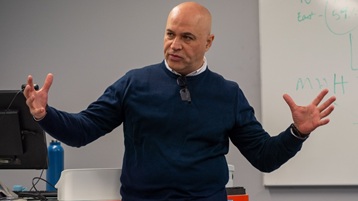
In 2025 and 2026, 16 academics from 13 countries will be teaching and conducting research at TH Köln as International Fellows. One of them is Dr Evangelos Favvas. In this interview, he talks about why he considers international exchange to be essential and how he was welcomed as an international visiting scholar at TH Köln.
Name: Dr. Evangelos Favvas
Institution: Institute of Nanoscience and Nanotechnology, NCSR «Demokritos», Greece
Host faculty at TH Köln: Faculty of Applied Sciences
Duration of stay: 1 October 2025 – 31 March 2026
I was interested in the International Fellowship because…
it offered me a unique opportunity to combine my long-standing research into membranes, porous materials and water treatment with an international and interdisciplinary environment at TH Köln, whilst at the same time contributing to a broader discussion on science, the sustainability transition and digitalisation in materials research.
Specifically, during the fellowship I wanted to…
advance research into the development of the microstructure of membranes during manufacture and investigate the use of digital tools in this process. I also wanted to establish new collaborations linking membrane science with sustainability-oriented research and teaching – which I succeeded in doing.
During my time in Germany, I wanted to find out…
how different academic and research cultures approach the integration of digital tools into experimental science, and how interdisciplinary and application-oriented research is developed at TH Köln and integrated into academic practice.
I believe that international exchange is…
essential for promoting academic excellence, innovation and long-term institutional cooperation. In fact, a memorandum of understanding has been signed between the NCSR ‘Demokritos’ and Cologne University of Applied Sciences, on the basis of which academic staff, researchers and students from both institutions can take part in short-term visiting programmes.
One difference between my home institution and TH Köln is…
the institutional context, as the NCSR ‘Demokritos’ is a national central research centre, whilst the Cologne University of Applied Sciences closely integrates applied research and innovation with teaching.
I am taking back to my local history research centre…
the realisation that close interaction between research, digitalisation and international cooperation can significantly enrich both scholarly work and academic culture, given that teaching is also a key priority at TH Köln.
What I like about TH Köln is…
that it combines an international focus with a strong application-oriented identity, creates scope for meaningful interdisciplinary collaboration, and welcomes visiting academics in such a way that they feel both academically challenged and personally integrated into the university community. Working with Prof. Stéphan Barbe’s research group gave me the strong feeling of being in my own laboratory, whilst at the same time making every day a truly new and enriching experience.
What I was really keen to experience in Cologne is…
not only academic life at the Cologne University of Applied Sciences, but also the city’s open and international character, its vibrant academic and cultural atmosphere, and the opportunity to live and work in an environment that combines local identity with a strong European perspective. The short distance between Cologne and Brussels has enabled me, through visits to the European Commission and various companies, to strengthen my professional network with researchers, consultants and other experts who live and work in the European capital.
About the ‘PLan_CV’ recruitment concept
The International Fellows Programme is a component of the PLan_CV project (‘Rethinking Academic Careers at Universities of Applied Sciences: Collaboration and Networking’). It aims to attract high-calibre candidates for professorships at TH Köln and to achieve greater permeability between academia and industry. The project is receiving €12.4 million in funding from the Federal Ministry of Research, Technology and Space as part of the programme to promote the recruitment and training of academic staff at universities of applied sciences.
July 2026