A look back and a look ahead: Prof. Dr Matthias Hochgürtel steps down as Dean
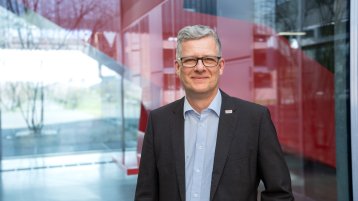
One chapter is coming to an end, and a new one is beginning: Prof. Dr Matthias Hochgürtel stepped down from his role as Dean of the Faculty of Applied Natural Sciences at the Leverkusen Campus on 30 June. From 1 July, he will take on new responsibilities as Vice-President for Research and Knowledge Transfer at the Cologne University of Applied Sciences.
The Faculty would like to express its sincere thanks for his dedication and, together with him, looks back on his time as Dean and forward to the Faculty’s future developments.
Since 2012, Prof. Dr Matthias Hochgürtel has served as Dean of the Faculty of Applied Natural Sciences, playing a key role in shaping its development and strategic direction. As Professor of Pharmaceutical Chemistry and Analytics, he will continue to carry out research at the Leverkusen campus.
Prof. Dr Matthias Hochgürtel, what were the most important milestones and highlights for you personally during your term as Dean of the Faculty of Applied Natural Sciences?
‘There have been several such developments in recent years. A key milestone was the accreditation and establishment of our degree programmes – first the Bachelor’s programmes and later the Master’s programmes as well. The Master’s programmes in particular were a real challenge, as they weren’t originally intended for us at all. I am therefore all the more pleased that we were able to launch the consecutive Master’s in ‘Applied Chemistry’ and the Master’s in ‘Drug Discovery and Development’ – the latter in close collaboration with the Faculty of Medicine at the University of Cologne. That was a particular highlight for me even back then.
The second major topic was, of course, the new campus – from its conception through to construction, the setbacks and finally the move. In my view, finally moving into the new building is one of the most important milestones we have achieved as a faculty. We are delighted to now be able to teach and conduct research here in a modern, attractive environment.’
How have you found the challenges of recent years – for example, in relation to digitalisation, research or teaching?
‘Essentially, setting up a new faculty – particularly in the early years – is fraught with challenges from start to finish. In my view, it was important that we tackled them as a team and very often found pragmatic solutions.
The COVID-19 crisis was certainly a major turning point: we had to react urgently and, ultimately, adapt our teaching methods. That required a rapid shift – but thanks to the groundwork laid by some of our colleagues and good organisation, we managed it well.
Of course, that period continues to have an impact. It still influences our work today, and above all it has shaped the students who lived through the pandemic. This has given rise to challenges that we have not yet been able to fully overcome and which continue to affect us.’
What were your visions and objectives for the faculty, and to what extent were these realised?
‘For me, it has always been about creating a research-intensive, dynamic faculty – one in which teaching and research work closely together. It was crucial to structure the institution in such a way that the infrastructure genuinely facilitates this collaboration and ensures short lines of communication and close interaction: between researchers, but also with students. This hasn’t always gone entirely smoothly, and there are, of course, the odd hurdle here and there. But on balance, given the way the faculty is structured today, we have reached a very good stage of development, from which we will, of course, continue to progress.’
What motivates you most in your new role as Vice-President for Research and Knowledge Transfer, and what overlaps do you see between your previous role and your new one?
‘Even as Dean, I have worked very closely across faculties and within the university as a whole over the past few years – and I would like to build on that. Of course, I am now moving well beyond a purely faculty-based perspective and have the opportunity to support collaboration – particularly in research – across the various faculties. And in doing so, I’m sure I’ll also learn just how different the faculties and their research approaches are. For me, that’s an exciting synergy.
‘I’ll have a great deal to learn – and will have to learn it – but this also opens up new opportunities. My experience from recent years, both within the faculty and through working with the other deans in the Faculty Conference, will certainly help me get off to a good start. It will enable me to achieve a great deal in this role – and, I hope, to further improve the framework conditions for research and knowledge transfer at the TH.’
Is there anything else you’d like to say to the new Dean?
‘I naturally wish the new Dean every success and hope they always have a knack for making the right decisions. In my view, the most important thing is to remain open-minded and to communicate and act transparently with colleagues and staff. I am sure the successor will manage this very well.’
Outlook for the Faculty’s Development
Prof. Dr Dirk Burdinski, Vice-Dean for Studies and Teaching, will take on the duties of Dean on an interim basis from 1 July. The newly elected Dean’s Office, as chosen by the Faculty Council, will begin its four-year term on 1 September 2026.
July 2026