


High-Tech for Everyday Life: TH Köln Develops Active Orthotic System for People with Arm Paralysis
Caring for patients with motor impairments in the upper limbs is a major challenge in modern rehabilitation. To support those affected in their daily lives and help reactivate paralyzed arms, a startup team from TH Köln is developing a novel active orthotic system as part of the “ExoAssist” project, set to be completed by mid-2028.
“While highly advanced prostheses are available today for people with amputated arms, there are currently very few active assistive devices for people with arm paralysis that are suited to their daily lives,” says Veith von Hahn, project manager of the startup initiative and research associate at the Institute for Product Development and Design Engineering at TH Köln. “People who suffer from arm paralysis—for example, due to an accident or a neurological disorder—often receive only passive arm splints. While these stabilize the affected arm, they leave it non-functional,” von Hahn continues. The team is therefore focusing on a motorized orthosis for the upper limbs that provides targeted support for movement.
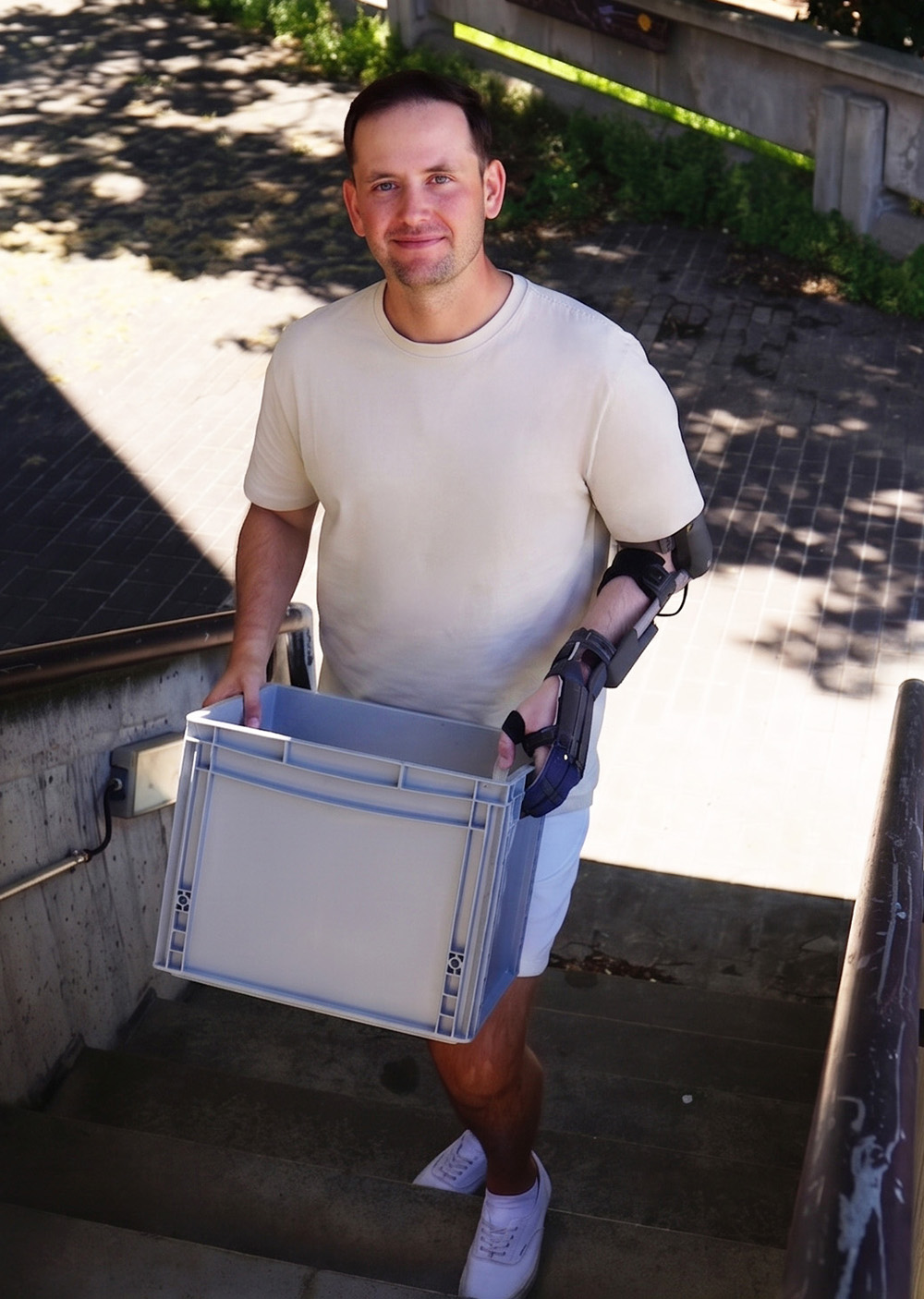
The modular system consists of four motor-driven segments for the shoulder, elbow, forearm, and hand. These are designed to be used individually or in combination to enable targeted movements of the affected parts of the arm. The orthosis is controlled by body signals: Specially developed EMG (electromyography) sensors detect even weak residual muscle activity on the skin’s surface. If the user’s own strength is insufficient for a movement, the system recognizes the user’s intention to move and executes it using its motors.
Gallery
 0 / 0
The “ExoAssist” project is developing an active orthotic system designed to support people with upper limb paralysis in their daily lives. (Image: Lea Dißelkamp)
 0 / 0
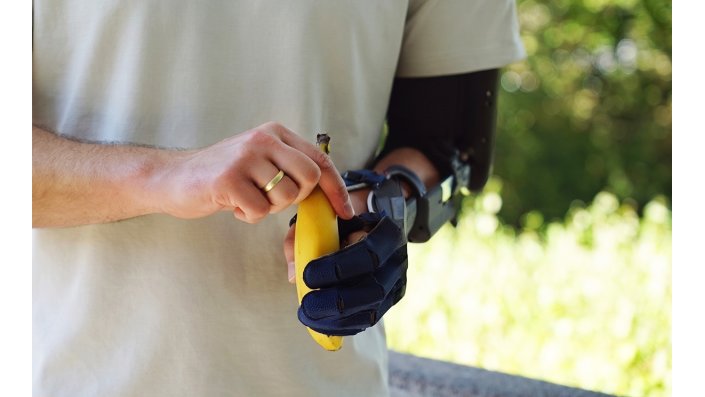
The modular system consists of four motor-driven segments for the shoulder, elbow, forearm, and hand. The orthosis is controlled by body signals detected by special sensors. Pictured here: Veith von Hahn, project manager of the startup initiative and research associate at the Institute for Product Development and Design Engineering at TH Köln. (Image: Lea Dißelkamp)
Innovation Born of Personal Experience
Von Hahn knows firsthand the hurdles faced by people with arm paralysis, as well as the limitations of conventional assistive devices. He himself has been living with arm paralysis since an accident. “In addition to the obvious limitations caused by the paralysis in daily life, many people suffer from secondary problems associated with not using the paralyzed limb—such as joint stiffness, poor posture, or pain,” says von Hahn.
The paralyzed arm becomes a burden that is tucked away in daily life and excluded by the brain as a body part. “A rigid splint can only provide very limited support in actively and functionally reintegrating the affected limb into everyday activities. It doesn’t help with getting dressed, cutting bread, or opening a door. “The goal of restoring a purpose to the arm in everyday life and thereby enabling those affected to regain more independence was and remains the driving force behind the project,” he continues.
Based on this experience, von Hahn, together with Prof. Dr. Jörg Luderich from the Institute for Product Development and Design Engineering at TH Köln, initiated the predecessor project “PlexoMotion.” The project was supported from 2022 to 2025 by the “Start Interaktiv” program of the Federal Ministry of Research, Technology, and Space. During this time, the team provided proof of principle that a sensor-controlled orthosis with the intended range of functions is feasible.
Press Release 38/2026
November 4, 2026
On the Path to Becoming a Medical Device
Building on this preliminary work, the orthosis system is now undergoing further technological development as part of the startup project “ExoAssist.” To this end, the interdisciplinary team combines expertise from the fields of Mechanical Engineering, software development, and medical technology. “The goal is to develop the system to the point where it can eventually be used as an approved assistive device. In addition to technical development, this will require further testing as well as the testing and approval procedures mandated for medical devices,” said von Hahn.
About the startup project
“ExoAssist” is funded with approximately 1.5 million euros by the Federal Ministry for Economic Affairs and Energy as part of the “exist Forschungstransfer I” program through mid-2028 and is co-financed by the European Social Fund (ESF). The team continues to be mentored by Prof. Dr. Luderich, who, as an expert in product development and entrepreneurship, contributes his experience in methodical product development, user-centered design, and the support of technology spin-offs. In addition, the project is supported by the coaches and infrastructure of Gateway TH Köln — the university’s central hub for startup support.
 Sponsors' Logos
(Image: TH Köln)
November 2026

