Around the world in 27 fellows: Dr. Katarina Poole
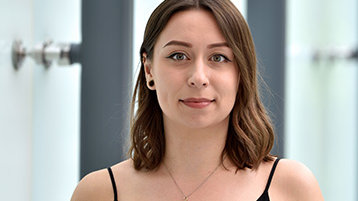
From 2025 to 2027, 27 researchers from 19 countries will be conducting their research and teaching at TH Köln as International Fellows. One of them is Dr. Katarina Poole. In this interview, she explains the benefits of international exchange and shares what’s great about the Mensa.
Name: Dr. Katarina Poole
Home university: Imperial College London, UK
Host faculty: Faculty of Information, Media and Electrical Engineering
Fellowship title: Cognitive inference of room acoustics
Duration of stay: October 1, 2026 – January 31, 2027
I was interested in the International Fellowship because...
it gave me the opportunity to run an independent project in a new field, with new international collaborators. As an early career researcher, that combination is rare and incredibly valuable.
Specifically, during the fellowship I wanted to...
learn more about room acoustics and auralisation with Prof. Christoph Pörschmann. Most auditory research, including my own, has been done without taking the room into account. I wanted to better understand how we listen in real life, in more ecological settings, and bring that into my work.
During my time in Germany, I wanted to find out...
what it’s like to research and live in a different country. I had only ever lived and worked in the UK, so this was a chance to experience a different academic culture and way of life first-hand.
I think international exchange is...
excellent, and we need more of it. Being embedded in another institution gives you access to people and fields you’d otherwise only reach through conferences. It also enables real two-way knowledge sharing, I’m learning room acoustics and auralisation, while bringing neuroscience methods like EEG and pupillometry to their work.
Something that is different at my home university than at TH Köln is...
the Mensa! Having a heavily subsidised canteen is great. TH Köln also has a large anechoic chamber and multiple listening rooms, whereas Imperial is in central London, so it’s difficult to get enough space for auditory experiments.
What I take back to my home university is that...
there are far more opportunities for funded international collaboration than I realised. I have already shared the International Fellows Programme with my network, along with other fellowships in Germany that I hadn’t heard of before coming here. I'll also be bringing back my new expertise in room auralisation and an ongoing collaboration with Prof. Pörschmann’s group.
What I like about TH Köln is that...
the research has a more applied focus. I come from a basic science background that turned towards engineering, so it has been really interesting to see the range of topics researched here and how closely the work connects to real-world applications.
What I really wanted to experience in Cologne is...
living abroad, and in a smaller city than London, as well as having the opportunity to practise and learn a new language. I also wanted to experience the Kölsch culture, and to explore the surrounding towns like Bonn and Koblenz to see the incredible castles and history.
About PLan_CV
The International Fellows program is part of the project PLan_CV („Professur-Laufbahn an Hochschulen für angewandte Wissenschaften neu denken: Collaboration und Vernetzung“). Its goal: Finding excellent candidates for professorial careers at TH Köln and achieving greater permeability between the academic world and the business sector. The project’s budget of 10.9 million Euros is funded through the Federal Ministry of Research, Technology and Space program “FH-Personal” (staff for universities of applied sciences).
November 2026