



Thermodynamic Facade: Higher Energy Efficiency, Lower Emissions
Optimizing the energy efficiency of facades offers enormous potential for savings. In the “EnergySkin” project, the TH Köln, together with partners from academia and industry, has developed a renovation system for non-residential buildings that is easy to install and minimizes heat loss. Components can be replaced, repaired, and recycled after use with minimal effort.
“The building sector offers great potential for further reducing energy losses and the associated CO₂ emissions. A key lever here is the building envelope. We demonstrate that it can be more than just a static insulation system: Our facade module supports local heat regulation and, among other things, generates its own electricity for this process,” says Prof. Dr. Pietro Di Biase from the Institute for Building Services Engineering (TGA) at TH Köln, who led the project together with research associate Max Stoppel.
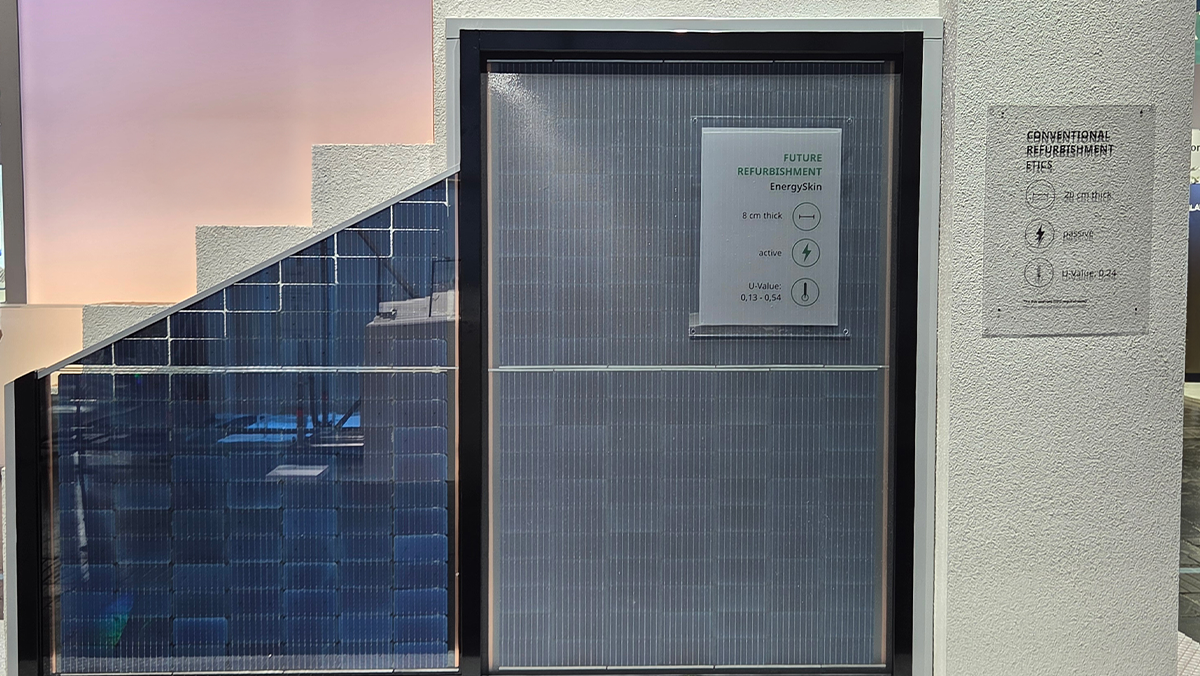
The physical prototype of the facade module consists of a heating element in the form of a transparent coating on a glass pane. This heats the facade and balances the temperature difference between the interior and the outside air, thereby minimizing heat loss. The insulated glass between the heating element and the facade enhances this effect through insulation. Sensors and a microcontroller regulate the power output of the heating layer according to demand. Solar cells are integrated and protected within the glass module, supplying part of the required energy, as Stoppel explains. “On sunny days, excess electricity flows into a battery. However, round-the-clock self-sufficiency cannot be guaranteed, so a grid connection is necessary.”
A post-and-beam construction allows for easy installation using screws and anchors. “Our system is designed as a plug-and-play solution. Some components can be replaced so they can be repaired later. The glass and aluminum used are recyclable,” reports Di Biase.
Gallery
 0 / 0
The facade module developed by TH Köln aids in thermal regulation and improves energy efficiency. (Image: Max Stoppel / TH Köln)
 0 / 0
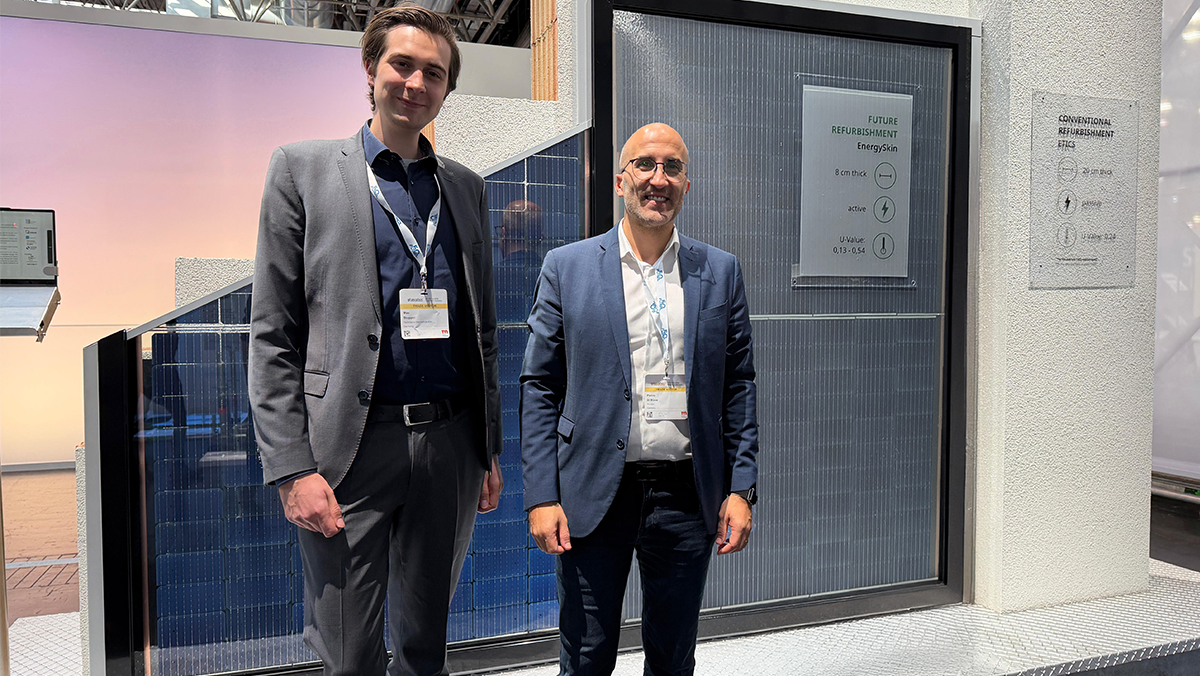
Project managers Prof. Dr. Pietro Di Biase (right in the photo) and Max Stoppel from the Institute for Building Services Engineering at the TH Köln - University of Applied Sciences presented the module at Glasstec, the world’s leading trade fair for the glass industry. (Image: Julia Seeger)
Simulations, optimizations, and field tests
Furthermore, the researchers developed the functions for control via a microcontroller and for the electrical connections to the heating layer. The prototype was then gradually tested for practical suitability using simulations and experiments in the TGA laboratory and in a climate chamber at TU Dresden.
“We were thus able to demonstrate that the mounting system does not cause thermal bridges – that is, weak points in the building envelope where heat is transferred to the outside more quickly than through the surrounding surfaces. We also determined how wide the air gap between the module and the wall should be to enhance the insulating effect, and what impact this has on moisture transport within the masonry. Furthermore, we determined that, in terms of energy efficiency, our design should ideally be installed on facades with east-south and west-south orientations, as solar radiation is higher in these positions,” Stoppel summarizes the results.
Press Release 39/2026
November 10, 2026
Approaches for Further Research
To improve the facade module, there are several potential avenues for follow-up projects: First, the addition of an AI-based control system to predict energy demands more precisely and thereby achieve greater energy efficiency. Second, the air gap could be used to cool the building envelope on hot days. The use of organic photovoltaic modules also holds promise. These carbon-based plastics and molecules utilize the photoelectric effect to convert sunlight directly into electricity. “Compared to conventional, silicon-based technology, these modules have a lower greenhouse gas potential, are lighter in weight, and are easier to recycle. Currently, however, their efficiency is insufficient, although partners are actively conducting research in this area,” Di Biase concluded.
About the Project
The project “Development of an Energy-Neutral Facade System for Exterior Wall Temperature Control” (EnergySkin) was carried out by professor Dr. Pietro Di Biase and research associate Max Stoppel from the Institute for Technical Building Systems at TH Köln. Dobler Metallbau GmbH was responsible for developing the mounting system. Flachglas Sachsen GmbH was responsible for manufacturing the glass module, including the installation of the solar modules. The Technical University of Dresden was responsible for calculating the structural integrity of the glass, conducting the life cycle assessment, and performing durability testing on the facade module. The Federal Ministry for Economic Affairs and Energy funded the TH Köln subproject with approximately 208,000 euros as part of the Central Innovation Program for SMEs (ZIM). The project ran for just over two years.
November 2026