


AI for Cell Research: TH Köln Student Takes Second Place in Kaggle Competition
Soheil Ayati, a student in the Master’s program in Automation & IT at the Gummersbach Campus of the TH Köln, took second place among 3,947 teams in the international competition “Biohub Cell Tracking During Development.” For his independently developed solution for automatic cell tracking, he received a Kaggle gold medal and prize money of $12,000.
How do cells move and divide during embryonic development? This question was the focus of a competition organized by the U.S. research organization Biohub on the Kaggle platform. Using three-dimensional microscopic images of zebrafish embryos, participants were tasked with developing algorithms that could identify individual cells and track their development over multiple time points.
The solutions had to do more than just determine where a cell is located and how it moves. They also had to detect cell divisions and reconstruct which daughter cells originated from which parent cell.
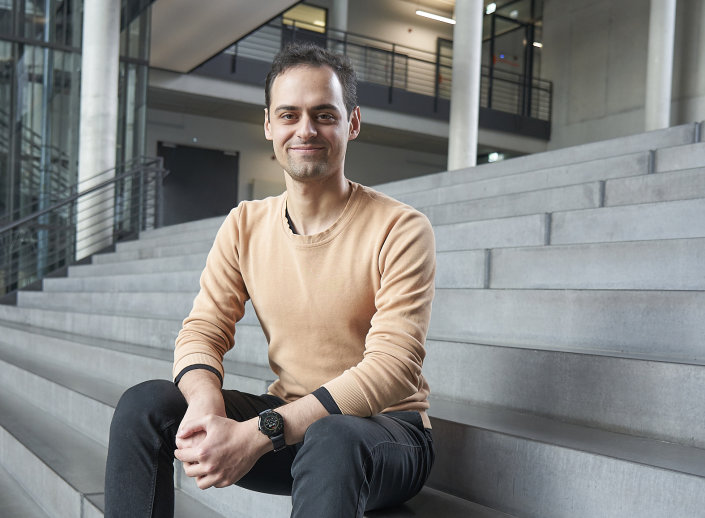 Soheil Ayati Kaggle
(Image: TH Köln, Monika Probst)
Tracking Cells Across Multiple Images
Biohub focuses, among other things, on the intersection of Artificial Intelligence and biological research. This task places high demands on automatic image analysis: In a developing embryo, numerous cells move simultaneously. They resemble one another, are closely packed together, and change their positions. Image noise further complicates detection. In addition, only a small portion of the cells in the training data had been manually labeled.
Therefore, simply recognizing a cell in a single image was not sufficient. The algorithms must correctly assign their identity across many consecutive images and distinguish between movement and cell division. Another challenge was that only a small fraction of the cells in the training data had been manually labeled. The competition thus combined Artificial Intelligence, Machine Learning, three-dimensional image processing, mathematical optimization, and biological research.
Soheil Ayati had to develop functional algorithms that could be applied to unknown microscopy data. Their results were evaluated using a standardized mathematical scoring system. Among other factors, the evaluation considered how reliably cells were linked across different time points and how accurately cell divisions were detected.
Benefits for Research: AI as a Tool for Developmental Biology
Automated cell tracking enables researchers to better study the formation and development of biological structures. Such analyses have traditionally been very time-consuming and require extensive manual work. Reliable AI algorithms can significantly accelerate this process and open up new possibilities for developmental biology as well as for the study of diseases and biological processes.
Ayati developed and tested his solution independently and optimized it through numerous experiments - spending countless hours and working frequent night shifts. This was the master’s student’s second time participating in a Kaggle competition. “My goal was to win and thereby inspire other students,” says the 25-year-old, who has already completed his degree in Electrical Engineering at the Gummersbach Campus. He left Iran to pursue his studies and moved to his new home in Gummersbach. Ayati is also involved in the development of autonomous robots as part of the VDI team. Ayati plans to donate a portion of the 12,000-euro prize money from the Kaggle competition.
Press Release 40/2026
dated November 11, 2026
Gold Medal in an International Field of Competitors
The organization provided a total of $60,000 in prize money for the competition. A total of around 4,500 people from 120 countries competed, organized into nearly 4,000 teams, including established software developers, engineers, and researchers from the fields of AI and image processing. A total of 95,438 solutions were submitted during the competition. By placing second, Soheil Ayati ranked among the top 0.05 percent of participating teams. A total of 17 teams received a gold medal.
Kaggle is owned by Google LLC and is one of the world’s largest platforms for Artificial Intelligence (AI), Machine Learning, and data science. Companies, research institutions, and other organizations use the platform to host competitions addressing technical and scientific problems.
November 2026