



30 Years of Networking
Since 1996, the Cologne Insurance Symposium has brought together experts from academia, business, politics, and regulatory agencies. The anniversary edition addresses a topic that will significantly transform the industry: “The Human Factor in the AI Transformation.” In this interview, the two organizers from the Institute for Insurance and Actuarial Science (ivwKöln) discuss their forum.
Prof. Dr. Michaele Völler, what role does the human factor play when it comes to introducing AI solutions in the insurance industry?
Völler: Whether AI solutions are successfully implemented and scaled depends not only on the technology, but also on the people who use them. A study by ivwKöln shows that even technically impressive AI solutions can fail in everyday business operations: If users don’t trust the system and therefore don’t use it, if they don’t understand the possibilities—but also the limitations—of AI, or if they use the tools differently than intended, even the best technology is of no use.
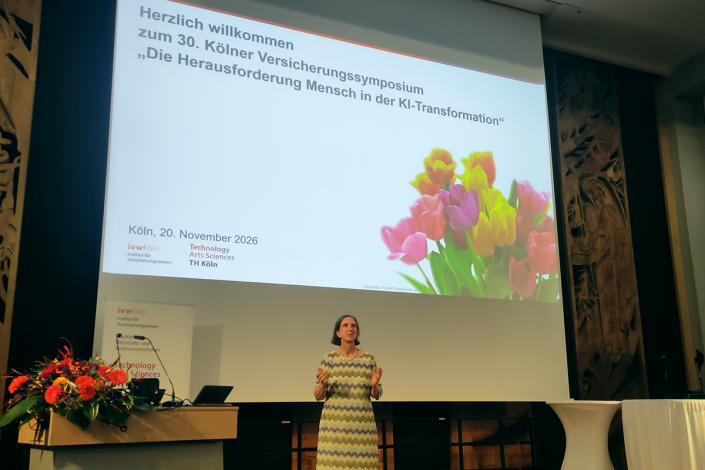 Prof. Dr. Michaele Völler, Director of the Insurance Market Research Group, during her opening remarks at the 30th Cologne Insurance Symposium.
(Image: Christian Sander / TH Köln)
Successful AI projects involve people by leveraging their skills and expertise and take their concerns and habits seriously. For successful implementation, the corporate culture, approach to mistakes, and the empowerment and leadership of employees are crucial.
Does the insurance industry face challenges in AI implementation that do not exist in other industries?
Völler: Fundamentally, the insurance industry is ideally suited for the use of AI, as it is a data- and knowledge-driven discipline; at its core, insurance is based on the analysis and assessment of data and risks. Modern AI methods in the field of deep learning, as well as modern memory and processor technologies, have significantly expanded this focus in recent years.
A particular challenge is and remains the product itself, where trust is still paramount even in the age of AI. Insurance is a forward-looking promise of benefits that, on top of that, many customers will never actually experience. Therefore, trust continues to play a central role. AI must therefore be used in such a way that trust is not undermined under any circumstances. Furthermore, the insurance industry is heavily regulated, and European regulatory authorities impose strict requirements, even in the context of AI.
In short: Not everything that is technically feasible is also sensible. For every specific problem, one should first consider what AI is technically capable of, what it is intended to achieve from an ethical, behavioral science, and business perspective, and what it is permitted to do under regulatory guidelines.
Prof. Horst Müller-Peters, ivwKöln is celebrating the 30th edition of the Insurance Symposium this year: How have the industry and the topics covered changed over this period?
Müller-Peters: Over the past 30 years, the industry has undergone a fundamental modernization and digitization; it has become more efficient, leaner, and more customer-oriented. Insurance managers, once so conservative, have become familiar with open-plan offices, online meetings, and informal address—and in the process have mostly forgotten how to tie a tie…
At the same time, however, the insurance business is very long-term in nature, as policies often run for 10, 20, or even 50 years. This results in a high degree of stability and consistency within the industry. The topic of our first symposium, for example, was private retirement planning—something that is once again on our agenda due to the Retirement Planning Reform Act, which takes effect on January 1, 2027. Other “perennial topics” include technological developments, the insurability of new risks—cyber risk insurance is currently a hot topic—and the legal regulation of the industry. Of course, social and global political events have also played a role, such as the COVID-19 pandemic at the 2021 symposium or the financial market crisis at the 2010 symposium.
We are pleased that we have consistently been able to attract high-profile advisors from the fields of research, industry, and government to address all these topics. Over the years, this has drawn nearly 15,000 visitors—including corporate professionals, students, and members of our alumni network—to our university’s auditorium. This integration of research and practice is particularly important to us, and we continue to foster it through numerous other events organized by the institute and our collaborative projects.
Take a look into the crystal ball: What topics will dominate the 60th Insurance Symposium?
Müller-Peters: Perhaps once again retirement planning, which—given demographic trends—will likely keep us busy for the next 30 years? But since technology and regulation are also constantly evolving and new risks are continually emerging for the industry, these topics are also likely to be on the agenda. Let’s just hope that no crisis takes center stage on the 60th anniversary and that real people will still attend the symposium in person—not just their avatars and AI agents. That would be a real shame, because traditionally, the event wraps up with Kölsch, pretzels, and lively networking.
November 2026