
INTIA
Under the title “My idea. My solution.”, the project piloted participatory methods for the development of digital aids to help children and young people with special needs cope with everyday life.
 INTIA Ergebnistagung
(Image: INTIA 2022)
INTIA Ergebnistagung
(Image: INTIA 2022)
Social work institutions and organizations are increasingly recognizing how socially relevant the lack of digital participation among their target groups is. However, they lack concrete individual solutions that are helpful for the participation and self-determined everyday coping of their target groups, reduce risks, do not require a great deal of effort to implement and operate, and can be used without any problems in terms of liability or data protection issues. Innovative approaches are being sought to introduce social work clients to the use of digital tools.
People receiving educational or integration support are less integrated into the digital world, which means less digital participation and a loss of potential everyday conveniences for them; due to their training, professionals have little media education expertise or knowledge of the potential of technologies. At INTIA, both groups participated as experts in inclusive technology development processes, supported by researchers and students from the fields of computer science, design, and social work. Everyday needs for assistance and participation were identified. The development of a digital building block principle and inclusive design methods in the everyday life lab enabled the target groups to invent, design, and adapt technological solutions themselves, thus experiencing self-efficacy. This building block system will continue to be available after the project has been completed. Cooperation partners from youth and disability services adopted this concept of mobile everyday life labs, supported by self-help initiatives, into their continuing education programs.
At a Glance
| Category | Description |
|---|---|
| Research project | INTIA | Inclusive development of methods and technologies for aids to cope with everyday life in disability and educational assistance |
| Management | Prof. Dr. Isabel Zorn |
| Faculty |
Faculty of Applied Social Sciences Faculty of Cultural Studies Faculty of Computer Science and Engineering |
| Institute |
Institute for Media Research and Media Education KISD | Cologne International School of Design Cologne Institute for Digital Ecosystems |
| Persons involved |
Prof. Birgit Mager Prof. Dr. Stefan Bente Prof. Dr. Christian Kohls |
| Sponsors | BMBF | Federal Ministry of Education and Research |
| Duration | 01.05.2019 – 31.07.2023 |
| Website | |
| Cooperation |
Diakonie Michaelshoven | Children and Family Services Michaelshoven gGmbH Evangelische Jugendhilfe Godesheim gGmbH (Protestant Youth Welfare Services Godesheim) FJMK | Specialist Center for Youth Media Culture |
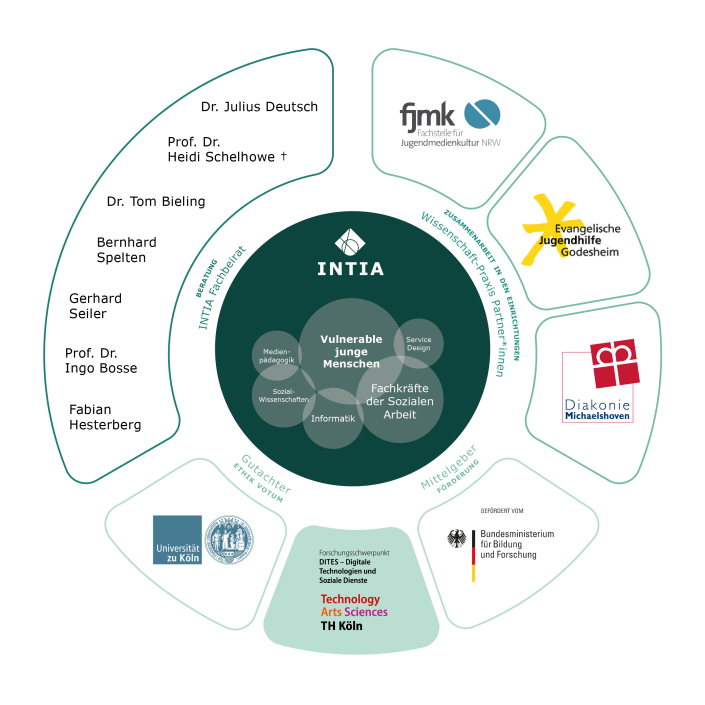 INTIA Netzwerkgrafik
(Image: INTIA 2023)
INTIA Netzwerkgrafik
(Image: INTIA 2023)
Research results
Once the project is complete, the findings and methods developed will be made available as freely accessible workshop concepts and open source technologies. This should enable interested institutions to organize seminars on the development of technical aids for everyday use. For long-term use and further development, there are also plans to set up a digital community platform aimed at social workers, affected individuals, self-help initiatives, and technology experts.
INTIA is aimed at people working in social services, IT, and science, as well as interested young people. On the INTIA website, you will find ideas and tools for solving everyday problems through the playful use of technology.
The platform provides a wealth of background information on the topic of “participatory inclusive technology development” as well as opportunities to get in touch with other interested parties.
- INTIA suitcase: The INTIA suitcase contains various tools, such as methods and technology modules. These can be used to better understand everyday needs. It is possible to develop technical solutions to problems and even build them yourself.
- Methods: These help you design, build, and evaluate everyday aids. Plus: Method radar to identify how participatory a method is.
- Knowledge: Definitions of terms, scientific texts, and references to publications.